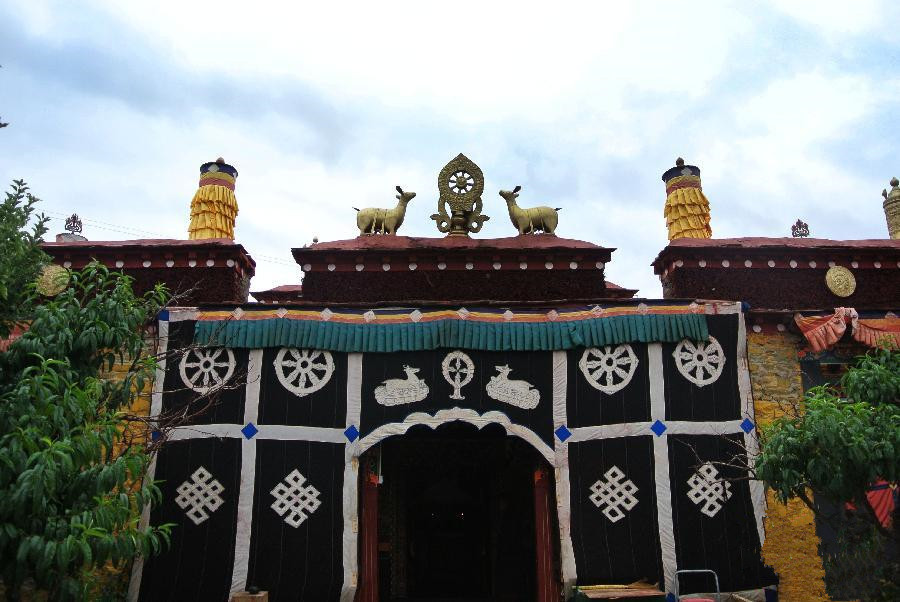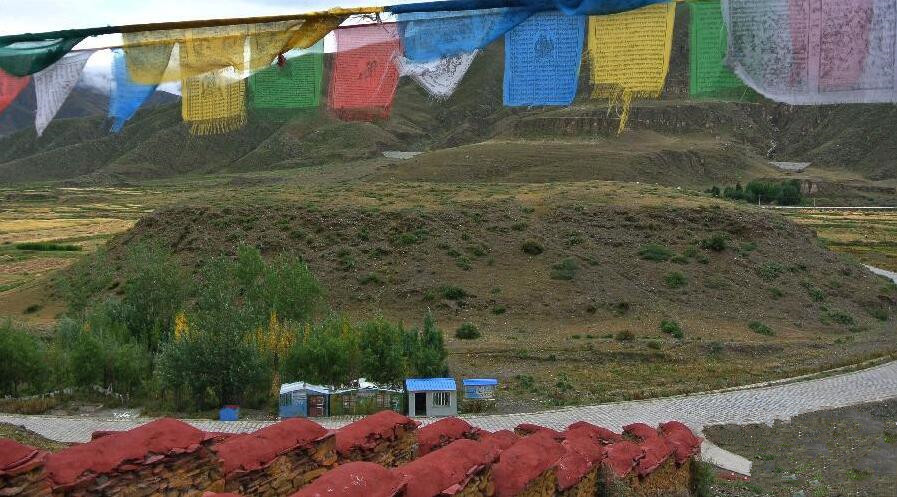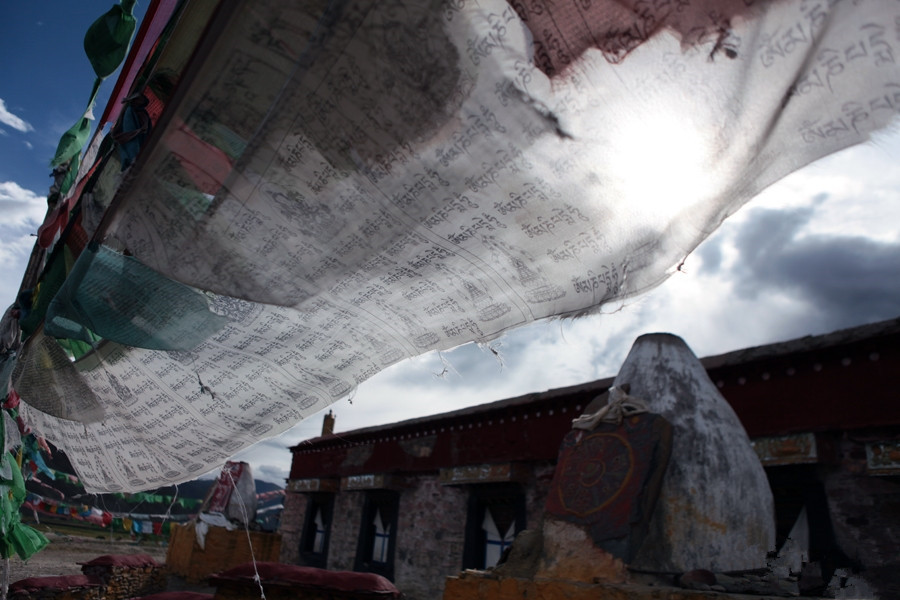
Srong bTsan sGam Po Tomb in Qonggyai County, Lhoka (Shannan)

The Tomb of King Srong btsan sGam po (松赞干布墓) is located in Qonggyai County (琼结县), Lhoka (Shannan), Tibet. It is one of the most significant historical sites in the region, marking the final resting place of King Srong btsan sGam po (松赞干布), the founder of the Tibetan Empire. The tomb lies on a flat plain near the Qiongjie River (琼结河), with a distance of 54 meters to the Mangsong Mangzan Tomb (芒松芒赞墓). The tomb is renowned for its grand structure and rich historical significance, showcasing the grandeur of the Tibetan Kingdom (吐蕃王国) and its royal customs.

The tomb’s mound, standing at a height of 13.4 meters, is composed of earth, wood, grass, and flat stones. The structure is both imposing and intricate, originally topped with an ancient temple, the “Zhongmu Zang Lhakhang” (钟木赞拉康), which was demolished during the Cultural Revolution (文革). This temple was used as a shrine housing statues of King Srong btsan sGam po, Princess Wencheng (文成公主), Princess Chizun (赤尊公主), and important figures such as Minister Lǔ Dōngzàn (禄东赞) and Thonmi Sambhota (吞弥·桑布扎), the creator of the Tibetan script.

Tomb Structure and Architecture

  • The tomb is aligned with a northeast orientation at 60 degrees, with significant evidence of earthwork and structural elements visible on all sides.

  • The southern wall is constructed with compacted soil layers, about 0.07 to 0.1 meters thick, mixed with small stones.

  • There are wooden beams embedded in the soil, leaving vertical holes. The holes are spaced at a distance of 0.15 meters vertically and 0.18 meters horizontally.

  • These walls are further supported by flat stones, and the surface layer is neatly decorated with white grass.

  • The tomb’s construction shows signs of damage, especially along the southern wall, where some of the earthwork has been disturbed by local habitation.

Historical Significance and Burial Customs

The tomb complex consists of five chambers (神殿), with the central hall housing the remains of King Srong btsan sGam po, Princess Wencheng, and Princess Chizun. Alongside these, the tomb also contains treasures such as gold and silver artifacts, weapons, and daily life objects from the Tibetan court. In addition to these, there are precious gifts from foreign rulers, including the Tang Emperor, Nepalese royalty, and neighboring kingdoms.

The burial site also includes exquisite pearl-studded items, such as two grams of pearls (about 56 pounds), and a knight statue crafted in pure gold. It is believed that the tomb complex once housed intricate statues of deities, including the Buddha Sakyamuni, Avalokitesvara, and various other figures central to Tibetan Buddhist practice.

Tibetan Legends and Tomb Layout

  • According to local legends and historical records, the tomb is designed to accommodate a grand underground palace, where sculptures of King Srong btsan sGam po, Sakyamuni, and Avalokitesvara are placed alongside precious objects such as golden armor and weapons used during King Srong btsan sGam po’s reign.

  • The central chamber is considered the main shrine, surrounded by four additional halls, each representing different elements of the king’s life, including his royal armor, gifts from neighboring nations, and ceremonial Tibetan religious icons.

  • The tomb’s original temple is said to have once featured twenty wooden halls, each dedicated to significant Tibetan figures, with the statues of King Srong btsan sGam po, Princess Wencheng, and other notable figures such as Minister Lǔ Dōngzàn and Thonmi Sambhota.

Visitor Information and Travel Tips

Best Time to Visit

The tomb is accessible year-round. However, it is best to visit during the spring and summer months, from April to October, when the weather is mild and the roads are more accessible. Winter can be challenging due to the high-altitude weather conditions.

How to Reach the Tomb

The King Srong btsan sGam po Tomb is located in Qonggyai County (琼结县), Lhoka (Shannan), Tibet. To visit the tomb:

  • By Road: The tomb is located in a flat region near the Qiongjie River (琼结河), and it is accessible via national highways and local roads. The site is near the Qiongjie River, making it easy to reach from nearby towns and villages.

  • By Car: It is recommended to travel by 4×4 vehicles with professional guides, as many roads in the region can be rugged and unpredictable. Travel along paved roads before transitioning to dirt paths closer to the tomb.

Altitude Considerations

The tomb is located at a high altitude, so visitors should be prepared for the highland climate and take necessary precautions to prevent altitude sickness. Acclimatization and warm clothing are essential.

Cultural Respect

As this is a historical and sacred site, visitors should dress modestly and show respect to the local culture. It is also advisable to avoid loud behavior and preserve the cleanliness of the surroundings.

Other Key Attractions Nearby

  • Chokpori Hill (卓古山): A sacred site near the tomb, known for its religious significance and stunning panoramic views of the surrounding Tibetan landscape.

  • Yarlung Tsangpo River (雅鲁藏布江): A major river that flows near the tomb site, perfect for those interested in exploring Tibet’s natural beauty.

Practical Information

  • Opening Hours: The tomb is open for visits daily from 7:00 AM to 6:00 PM.

  • Entry Fee: The tomb has an entrance fee, which varies depending on the season. Please check locally for updates before visiting.

This historical site is not just a tomb but a symbol of the rich Tibetan culture and the legacy of King Srong btsan sGam po, whose reign laid the foundation for the Tibetan Empire and played a pivotal role in shaping the cultural and political relations between Tibet and China.