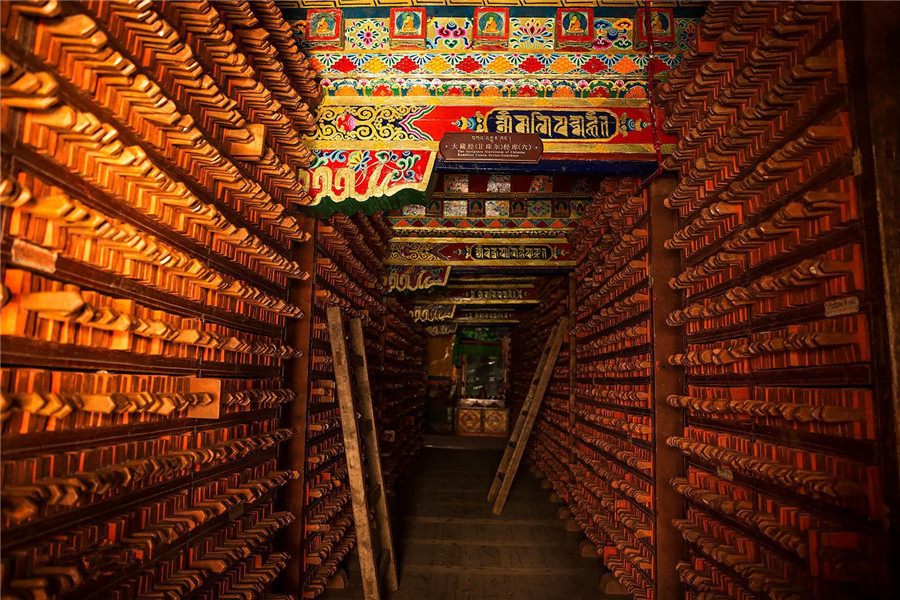
Derge Parkhang in Dege County, Garze
Derge Parkhang, also known as Dege Sutra Printing Temple (德格印经院), is one of Tibet’s most significant cultural and religious institutions. Located in Gengqing Town (更庆镇), Dege County (德格县) in Garzê Tibetan Autonomous Prefecture (甘孜藏族自治州), Sichuan Province (四川省), China, Derge Parkhang is an active center for the printing and preservation of Tibetan literature, serving as a living repository of Tibetan Buddhist scriptures, historical texts, and cultural artifacts. This unique institution continues the tradition of woodblock printing, a practice that has been an integral part of Tibetan culture for over 300 years.
Historical Background
Founding of Derge Parkhang
Derge Parkhang was established in 1729 by Demba Tsering, the 40th King of Derge (1678–1739), with the spiritual guidance of the 8th Tai Situ Panchen Chokyi Jungne (第八世台寺藏传宗教高僧). Located in the Kham region, this printing temple was built to preserve and print Tibetan sutras, commentaries, and other important cultural documents. The construction of the Parkhang took 27 years, during the rule of the 12th, 13th, and 14th kings of Derge, and it has remained an essential hub of Tibetan culture ever since.
Cultural Significance
Derge Parkhang is one of the most prominent printing centers for Tibetan Buddhism in the world. Its legacy has shaped the Tibetan religious and cultural landscape, and it continues to serve as a major source of knowledge, supporting scholarly research in various fields including Buddhism, medicine, history, literature, and arts.
Architectural Features
Design and Layout
Derge Parkhang is located on a small hill at the edge of the Euqu River (欧曲河) in Dege County, taking full advantage of the surrounding natural landscape. The architecture of the complex features traditional Tibetan design with an emphasis on wooden structures and red walls, symbolizing the ancient and dignified culture of Tibet.
The layout of the Parkhang follows a unique “回” (return-shaped) floor plan, which is both practical and symbolic. The outer walls are constructed from red-brown clay and form a massive and solid structure, creating a sense of grandeur and protection. The central courtyard is rectangular, flanked by buildings that rise in several tiers due to the sloping terrain.
The main buildings include:
-
North Building: The largest and most important structure, with a three-story design that houses the Great Sutra Hall (大经堂) and the Small Sutra Hall.
-
East and West Buildings: Both four-story buildings, built on different foundations (one on an excavated base, the other on a filled one), house various workspaces, including woodblock storage and printing areas.
-
South Building: A three-story structure used for sutra printing, with an open corridor on the top floor, ensuring ample ventilation for the printing process.
Building Materials and Construction
The Parkhang is built using local materials, and the structure adheres to the traditional Tibetan architectural style. The walls are made of adobe bricks, and the floors and ceilings use wood extensively. The buildings are designed to blend harmoniously with the natural surroundings, integrating into the sloping hillside and following the contours of the land.
Cultural and Religious Importance
Woodblock Printing Tradition
Derge Parkhang is renowned for its woodblock printing tradition, which has been continuously practiced since its establishment in the 18th century. The monastery houses a collection of over 320,000 woodblocks, many of which are inscribed with Tibetan Buddhist scriptures, as well as texts on subjects like astronomy, medicine, literature, history, and poetry.
The woodblock printing process involves several intricate steps:
-
Carving the text onto wooden blocks.
-
Ink preparation and printing onto paper.
-
Drying and binding the printed sheets into books.
This complex process ensures the high quality and preservation of Tibetan texts, which are often printed in red cinnabar ink. It is said that one pair of artisans can print up to 2500 pages a day, continuing the centuries-old tradition that has made Derge Parkhang a central institution for Tibetan literature.
Significant Texts and Manuscripts
The woodblocks at Derge Parkhang include important Buddhist scriptures, such as:
-
The Kanjur (甘珠尔) – The collection of Buddhist teachings.
-
The Tanjur (丹珠尔) – Commentaries on the Kanjur by scholars and Tibetan teachers.
-
Medical and astronomical texts.
-
Historical records and poetic works.
Among its most treasured collections, the Parkhang preserves rare texts like the Indian Buddhist origins and early medical works such as the “Four Medical Texts” (四部医典).
Murals and Sculptures
The murals within Derge Parkhang span approximately 950 square meters, with 95% of them being ancient and valuable works. These murals, created by various schools, including the Karma Kagyu (噶玛噶则) school, depict Buddhist deities, protectors, and Bodhisattvas.
Additionally, there are 75 mud sculptures spread across the main halls, representing historical Buddhist figures, such as Buddha, Bodhisattvas, monastic leaders, and other revered religious figures.
Recognition and Protection
UNESCO Intangible Cultural Heritage
In 2009, the woodblock printing technique at Derge Parkhang was inscribed on the UNESCO Intangible Cultural Heritage of Humanity list, recognizing its global cultural importance. This recognition underscores the traditional craft’s significant role in preserving and transmitting Tibetan culture.
Protection Efforts
Over the years, the Parkhang has undergone extensive renovation and preservation efforts:
-
In 1980, the Sichuan Provincial Ethnic Affairs Commission initiated a large-scale repair project, replacing deteriorated beams and reinforcing structural elements.
-
In 2004, further repairs were conducted to protect the wooden blocks, mural paintings, and the building’s structure with a budget of 1.6 million RMB.
-
Since 1996, Derge Parkhang has been classified as a National Key Cultural Heritage by the Chinese State Council.
In 2024, Derge Parkhang’s woodblock archives were added to the Asia-Pacific Memory of the World Register, cementing its status as one of the world’s most significant cultural repositories.
Visiting Derge Parkhang
Location
Derge Parkhang is located in Gengqing Town (更庆镇), Dege County (德格县), Garzê Tibetan Autonomous Prefecture, Sichuan Province, China. The temple is easily accessible by foot from the Dege County People’s Government.
Transportation
-
By Foot: Visitors can walk approximately 250 meters from the Dege County People’s Government to reach Derge Parkhang in about 4 minutes.