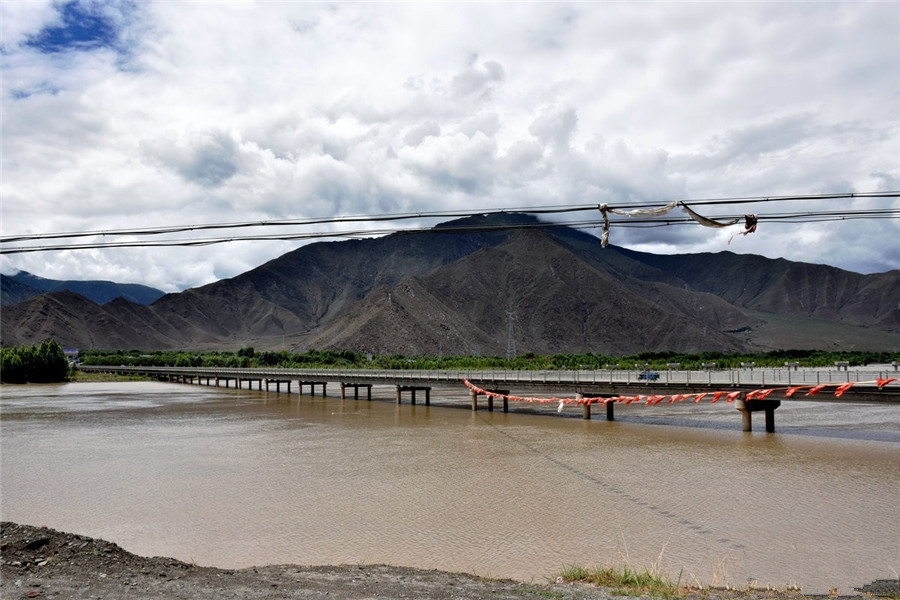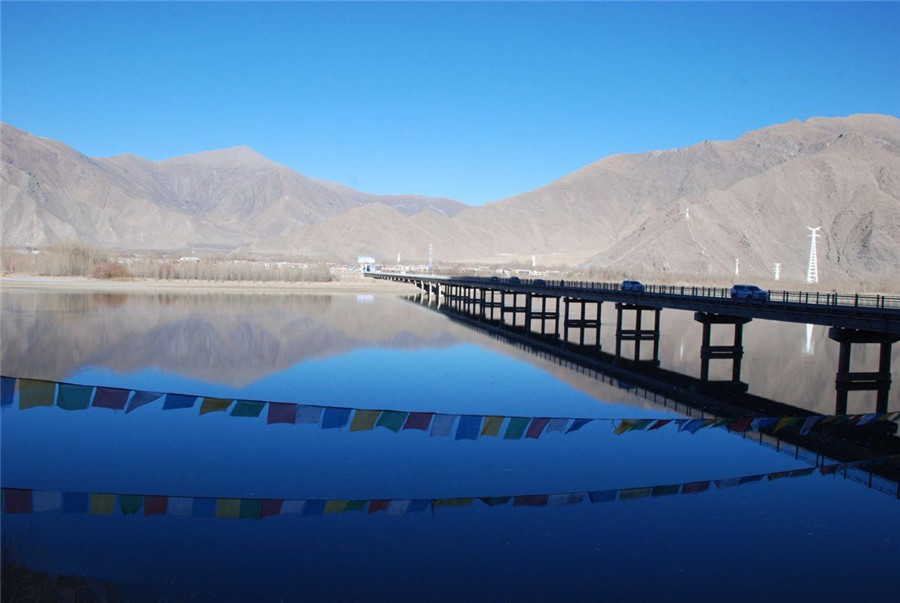
Quxu Bridge in Quxu County, Lhasa
Quxu Bridge (曲水大桥) spans the Yarlung Tsangpo River (雅鲁藏布江) in Quxu County (曲水县), located approximately 60 kilometers southwest of Lhasa (拉萨). Completed on August 1, 1966, the bridge serves as an essential transportation link between Lhasa and Gonggar Airport (贡嘎机场), and has historical significance as one of Tibet’s key infrastructure projects.
Geographical Location
The Quxu Bridge is situated on the Yarlung Tsangpo River (雅鲁藏布江), which is a major river flowing through the Tibet Autonomous Region (西藏自治区). The bridge connects Quxu County to the larger transportation network of the region. Driving east from the bridge, visitors can reach Gonggar Airport, and taking a right turn leads toward the Yamdrok Lake (羊卓雍错). The Quxu Bridge is a crucial passageway for travelers heading toward Gonggar Airport.
The Lhasa River (拉萨河), a tributary of the Yarlung Tsangpo River, flows gently through the region, with sandbars and shrubs dotted along the riverbanks. The bridge measures approximately 300 meters in length and 10 meters in width, and serves as a vital bridge for local transportation, especially for access to Gonggar Airport.
Strategic Transportation Hub
The Quxu Bridge is an essential transportation hub with significant strategic importance in Tibet. The G318 National Road (G318国道) passes through the northern side of the bridge, connecting major routes such as the Sichuan-Tibet Highway (川藏公路), Yunnan-Tibet Highway (滇藏公路), and the Qinghai-Tibet Highway (青藏公路). To the west, the road leads south through Shigatse (日喀则) to the Zhangmu Port (樟木口岸), which connects Tibet to Nepal and eventually leads to Kathmandu. To the north, it connects to Duilongdeqing County (堆龙德庆县), providing access to the Qinghai-Tibet Railway.
The bridge is a gateway to the southern Tibetan region, with direct access to Gonggar, Linzhi (林芝), and Sikkim (锡金) through various regional roads. The Quxu Bridge plays an essential role in connecting Tibet’s various important highways.
Because of its strategic position, the bridge is under strict security, and there are no streetlights along the structure. At night, vehicles passing through are required to turn off their headlights.
Former Chakzam Bridge in Quxu County
(古桥: 查卡藏布大桥)
The Chakzam Bridge (查卡藏布大桥), also known as Chushul Chakzam, was an iconic suspension bridge built in 1430 near Lhasa (拉萨), Tibet. Commissioned by Thang Tong Gyalpo (唐通刚波), a prominent Tibetan figure, the bridge was a marvel of its time, featuring the world’s longest unsupported span, approximately 137 meters. This was a historic bridge, as there were no other suspension bridges at that time.
Quxu Bridge’s Historical Significance
The Quxu Bridge, officially known as Quxu Yarlung Tsangpo Bridge (曲水雅鲁藏布江大桥), is an important infrastructure project in Tibet. It was completed in 1966 with an investment of 3.5458 million yuan and a construction team of over 1,000 workers. The bridge is essential for travelers on the G318 National Road, connecting Lhasa to Gonggar Airport, Yamdrok Lake, and key parts of the region.
Historically, the bridge has served as a gateway for travelers and goods between Tibet and Nepal, as well as a crucial point of access for those heading to Shigatse, Linzhi, and other areas in southern Tibet.
Declining Strategic Importance and Preservation
After the “Two Bridges and One Tunnel” Project (两桥一隧工程) was completed in 2005, the strategic importance of the Quxu Bridge gradually declined. However, the bridge continues to hold cultural and historical value, and was recognized as a Level 3 Dangerous Bridge (三级危桥) in 2016.
A new Quxu Bridge was completed in 2019, located 300 meters east of the original bridge. The original bridge is now out of service but is planned to be preserved as a patriotic education site with a focus on red culture. It is currently maintained by the Zanang Road Maintenance Division (扎囊公路养护段).