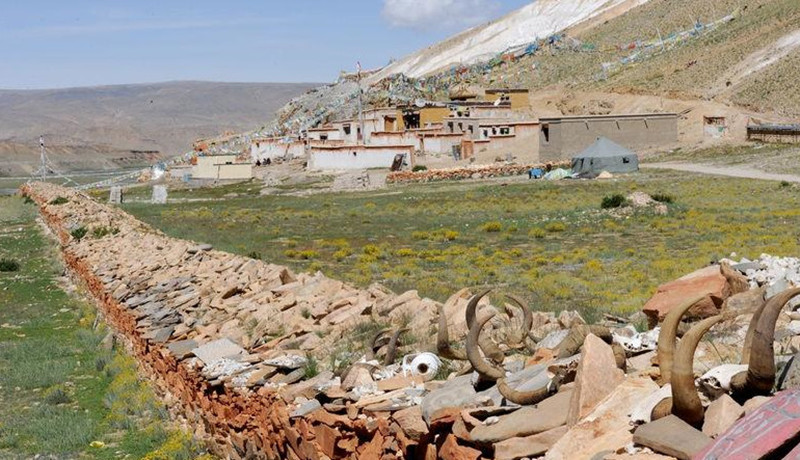
Zhida Buri Monastery in Gar County, Ngari
Zhida Buri Monastery (直达布日寺) is a Tibetan Buddhist temple located in Menzi Township (门士乡), Gar County (噶尔县), in the Ngari Region (阿里地区) of Tibet. The monastery is situated approximately 60 kilometers from Gangrenboqi Sacred Mountain (岗仁波钦神山) and was originally founded by the prominent Nyingma Lama Doza Quni Sangbu (多扎·曲尼桑布) in the 8th century. Initially affiliated with the Nyingma sect (宁玛派), the monastery later adopted the Kagyu sect (噶举派) teachings and is currently a branch of the Pulan Shepelin Monastery (普兰谢佩林寺).
Historical Background and Construction
Foundation and Early History
The monastery was first established by Doza Lama Quni Sangbu in the 8th century as part of the Nyingma tradition, a key school of Tibetan Buddhism. Following its foundation, the temple underwent several changes. In 1947, it was destroyed by Kazakh invaders but was later rebuilt by Lama Yixi Bandan (益西班丹), who became its abbot. Over time, the monastery came under the administration of Pulan Shepelin Monastery, yet it continued to follow the teachings of the Kagyu sect.
Religious Significance
According to the Nyingma Great Perfection (Dzogchen) teachings, the monastery is considered to be one of the Eight Underground Palaces (地下八政), a sacred site associated with the Vajra Yogini (金刚亥母). The monastery’s sacred status is further reinforced by its association with several important figures, including Padmasambhava (莲花生大师), Amitabha Buddha (无量光佛), Shakyamuni Buddha (释迦牟尼佛), Yixi Tsojie (空行母益西措杰, Padmasambhava’s consort), and Dorje Pham (多吉帕姆, a key figure in Tibetan Buddhism).
The monastery is known for its sacred footprints of Padmasambhava at the age of 8 and the relics of Padmasambhava, Dorje Pham, and Guocangwa (果仓哇). The temple also features several meditation sites associated with these figures.
Iconography and Sacred Relics
Among the primary figures worshipped in the monastery are statues of Padmasambhava, Amitabha Buddha, Shakyamuni Buddha, and Yixi Tsojie, along with the footprints of Padmasambhava at the age of 8. The monastery is home to several sacred sites, including those dedicated to Padmasambhava, Guocangwa, and Dorje Pham. A hot spring near the temple creates a marble-like deposit around its source, and pilgrims collect stones called Gangti (岗提) believed to have the power to cure ailments.
Surrounding Sacred Landscapes and Rock Formations
Sacred Rocks and Symbols
The area surrounding Zhida Buri Monastery is rich with sacred natural features. Weathered stone forests symbolizing various deities can be found, including Mahakala (大黑天) and the Garuda (天鹏鸟). Beneath the Garuda rock, there is a white clay known as Qiongsa (琼萨), which is said to have special healing properties for polluted water and soil.
On the western bank of the river, a purple rock represents the Palace of the 100,000 Sky Dancers (十万空行母宫), with a flat ground below thought to be the dance stage of the Sky Dancer. Nearby, red and white rocks form the Sky Dancer’s secret path, while yellow and blue rocks represent the Wealth God (财神) and the Lion-faced Sky Dancer (狮面空行母宫), respectively.
A temple dedicated to the protectors stands among the river’s rocky formations. Inside this temple, a cave houses a statue of Mahakala, an important protective deity in Vajrayana Buddhism. Mahakala, revered as the **wrathful manifestation of Vairocana Buddha (大日如来), is considered the head of all protective deities.
Other Sacred Sites
In addition to the rock formations, the surrounding area is dotted with meditation sites, including a cave that once belonged to Guocangwa. This cave has been sealed off, with access restricted to protect the sacred space. The shrine inside houses sacred relics such as Mahakala and a sacred stone that was retrieved from a holy lake, further enhancing the site’s mystical and spiritual significance.
Reconstruction and Preservation
Cultural and Religious Revival
The monastery was severely damaged during the Cultural Revolution, but in 1983, the Chinese government provided funds for its reconstruction. Today, the monastery remains an important center of Tibetan Buddhism, hosting two lamas and two administrative staff. It continues to serve as a site of pilgrimage for Buddhists from all over Tibet and beyond.
Restoration and Current Status
Zhida Buri Monastery, after its restoration in the 1980s, maintains its central focus on the worship of Padmasambhava, Amitabha Buddha, and Shakyamuni Buddha, while also preserving important relics such as the footprints of Padmasambhava at the age of 8 and the statues of Yixi Tsojie and Dorje Pham.
Natural Features and Pilgrimage Traditions
The hot spring and its marble-like landscape continue to attract pilgrims who collect Gangti stones for their purported healing properties. The surrounding stone forests have become integral to the site’s religious and cultural identity, symbolizing various Buddhist deities and serving as a testament to the monastery’s deep connection with the natural world and spiritual practice.
Visiting Zhida Buri Monastery
Opening Hours and Admission
While the monastery does not have formal opening hours, it is generally accessible to visitors during daylight hours. It is recommended to confirm timings and any specific access restrictions with local authorities before planning a visit. There is no entrance fee for the monastery, though donations are welcomed to support the continued preservation and upkeep of the site.
Getting There
The monastery can be reached via road from Gar County, with a short hike required to reach the temple itself. Local transport services can be arranged, and it is advisable to check with tour guides or local authorities for more specific travel information.