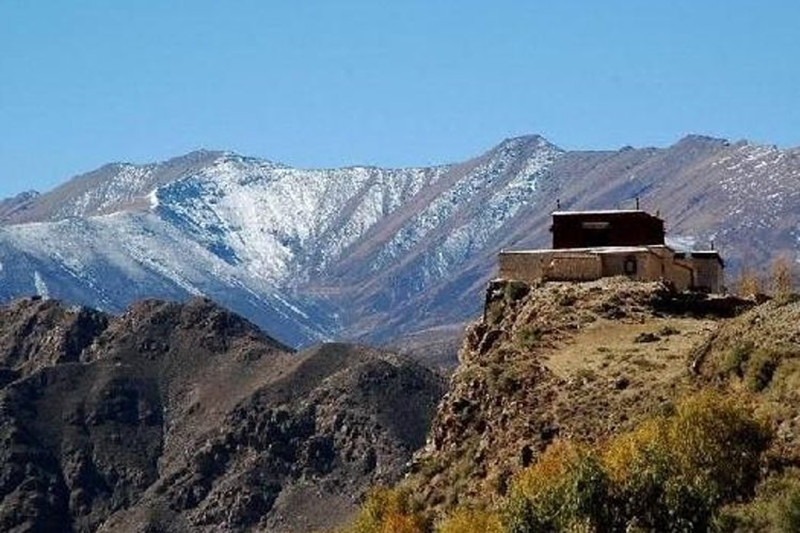
Kamadang Temple in Sangri County, Lhoka (Shannan)
Kamadang Temple (卡玛当寺) is a historical Tibetan Buddhist monastery located about 2.5 kilometers east of Sangri County (桑日县) in Lhoka (山南) Prefecture, Tibet, nestled on the side of a mountain. Originally established in the 11th century, the temple has undergone several transformations, reflecting Tibet’s dynamic religious history. Initially founded as a Kadampa (噶当派) monastery, it later transitioned to the Xijie (希解派) or Mogyi (莫吉派) sect in the mid-11th century. By the 17th century, it became a Gelugpa (格鲁派) monastery, while still retaining elements of Xijie rituals.
Historical Background and Reconstruction
Kamadang Temple was destroyed during the Cultural Revolution but was rebuilt in 1986. The temple’s main deity is a statue of Mogyi Logi Drolma (莫吉洛吉卓玛), a pioneering female figure in Tibetan Buddhism. Mogyi Logi Drolma founded the Mogyi sect (能断派), combining elements of Xijie and Kadampa traditions, with her unique style of drum chanting rituals. Her contributions had a profound influence on Tibetan Buddhism, especially in enhancing the role of women within the faith.
The Life of Mogyi Logi Drolma and the Mogyi Sect
Mogyi Logi Drolma (玛吉拉珍)
Mogyi Logi Drolma, a female Tibetan Buddhist practitioner of the 11th century, is considered the first female Tibetan Lama and the founder of the Mogyi sect (能断派). She combined teachings from the Xijie sect (希解派) with Kadampa (噶当派) principles to create a distinctive tradition, known for its drum chanting rituals, a departure from the typical Buddhist ceremonies of the time. Mogyi Logi Drolma’s teachings focused on Prajñāpāramitā (般若性空) and emphasized the emptiness doctrine (空), aiming to overcome ignorance and attachment, the root causes of suffering.
Her role in Tibetan Buddhism was groundbreaking, as it was uncommon for women to hold significant religious positions during that period. Her establishment of a female monastic order (摩觉) helped elevate the status of women in Tibetan Buddhism, and the Nengduan sect (能断派) she founded remains the only Tibetan Buddhist sect to have spread to India (印度). Her influence extended beyond Tibet, and her followers can be found in Sikkim (锡金), Nepal (尼泊尔), and India (印度).
Mogyi Sect and Its Impact
The Mogyi sect (能断派) is grounded in the Prajñāpāramitā philosophy (般若性空), with a focus on emptiness and the eradication of self-attachment. It was a revolutionary movement that aimed to break from conventional Buddhist practices by introducing the drum chanting ceremony, a central ritual in the Mogyi sect. This sect, unique in its form, had a lasting impact on Tibetan Buddhist teachings and spread far beyond Tibet, especially in India (印度), Nepal (尼泊尔), and Mongolia (蒙古).
Mogyi Logi Drolma’s ideas and the Mogyi sect became influential in the development of other schools of Tibetan Buddhism, including the Sakya (萨迦派), Kagyu (噶举派), and Gelug (格鲁派) traditions. Her legacy is not just theological but also cultural, as she paved the way for women’s participation in Tibetan Buddhism, a domain historically dominated by men.
Kamadang Temple Today
The current structure of Kamadang Temple (卡玛当寺) retains many features from its original Xijie sect (希解派) rituals, including the drum chanting and other unique practices established by Mogyi Logi Drolma (玛吉拉珍). The temple continues to serve as a pilgrimage site for followers of the Mogyi sect and is a symbol of the continued empowerment of women in Tibetan Buddhist traditions.
The temple’s main idol, Mogyi Logi Drolma (莫吉洛吉卓玛), is revered by many. Kamadang Temple remains a place of spiritual learning and a center for the Mogyi sect‘s teachings.
Getting to Kamadang Temple
Sangri County (桑日县) is easily accessible by road, with the main route being the Zedang to Sangri (泽当至桑日) asphalt road. The temple is situated about 2.5 kilometers east of the county center, making it easy to visit by car.
Travel Tips for Visiting Kamadang Temple
Cuisine in Lhoka (山南)
The cuisine of Lhoka (山南) is similar to that of other regions in Tibet, with a notable influence from Sichuan (四川) due to its proximity to the province. Commonly found dishes include:
-
Tsampa (糌粑): Roasted barley flour, a staple food in Tibet.
-
Yak Butter Tea (酥油茶): A traditional drink made with yak butter and tea.
-
Mutton and Beef (羊肉和牛肉): Often served in stews or grilled.
-
Tibetan Dumplings (包子): Filled with meat or vegetables.
-
Sweet Tea and Milk Tea (甜茶和奶茶): Popular beverages.
-
Mushroom and Dried Meat (风干肉): Local specialties made from yak meat and wild mushrooms.
Accommodation
There are various guesthouses and hotels in Sangri County (桑日县). Most offer affordable rates, but the quality can vary. It’s advisable to confirm the facilities and hygiene standards before booking.